Multi Treadmill Repair Service Contract: 2026 Guide
A multi treadmill repair service contract is a structured agreement that covers preventive maintenance, emergency repairs, OEM parts, and certified technician visits across multiple treadmill units under a single plan. For fitness facility owners managing Life Fitness, Precor, or NordicTrack fleets, and for home gym users running two or more machines, this type of contract controls costs, reduces downtime, and extends equipment lifespan in ways that one-off repair calls never can. The right treadmill maintenance agreement shifts you from reactive firefighting to predictable, budgeted upkeep. This guide breaks down what to look for, how pricing scales, and what mistakes to avoid before you sign anything.
What does a multi treadmill repair service contract include?
The strongest repair contracts for treadmills share a common structure, and knowing each component prevents you from paying for coverage that leaves gaps when you need it most.
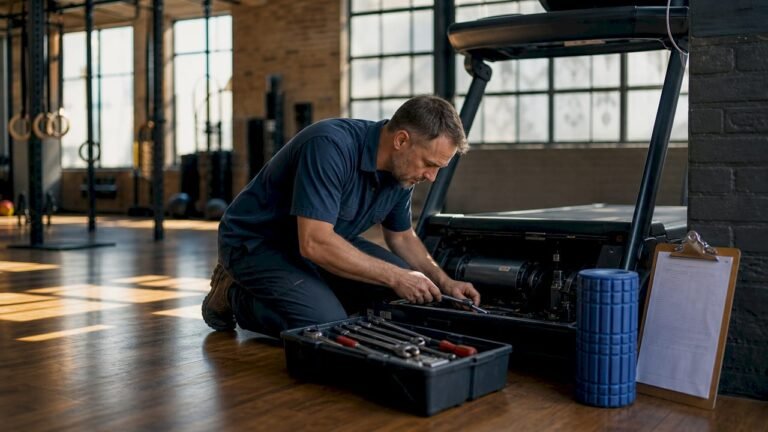
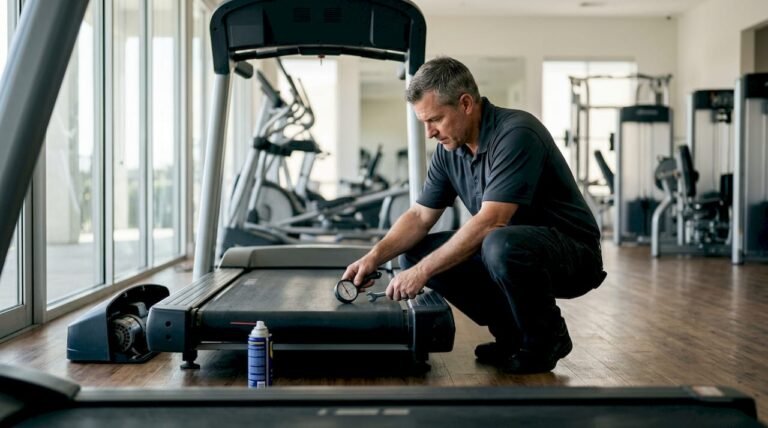
Preventive maintenance visits are the backbone of any agreement. At least 4 visits per year is the industry minimum for commercial gyms, with a 2 to 4 hour emergency response SLA written into the contract. That response window matters because a broken treadmill during peak hours costs you member trust, not just repair fees.
OEM parts inclusion separates a real contract from a labor-only arrangement. A contract that covers only technician time leaves you exposed to retail markup on belts, motors, and control boards every time a component fails. Parts-included contracts deliver budget predictability that labor-only agreements simply cannot match.
Here are the non-negotiable elements to verify before signing:
- Minimum preventive maintenance visits per year (4 for commercial, 2 for light home gym use)
- Emergency SLA timeline with written penalty clauses for missed response windows
- OEM parts coverage, not just labor
- Signed service reports for each machine after every visit
- Manufacturer authorization and technician certification documentation
- Climate and usage-adjusted service intervals for your specific region
Pro Tip: Ask every prospective provider to show you a sample signed service report. If they cannot produce one, their documentation process is not audit-ready, and that creates liability exposure for your facility.
That last point on climate adjustment is frequently overlooked. Service intervals must account for local climate and usage intensity, not just follow global manufacturer schedules. In South Texas, heat and humidity accelerate belt wear and motor strain at a rate that standard quarterly schedules do not address. A provider who ignores your environment is selling you a generic product, not a tailored fitness equipment repair plan.
| Contract element | Why it matters |
|---|---|
| OEM parts included | Eliminates retail markup and ensures compatibility |
| Emergency SLA with penalties | Holds the provider accountable for response time |
| Signed per-machine reports | Protects you legally and satisfies insurance requirements |
| Certified technicians | Preserves manufacturer warranty and repair quality |
| Climate-adjusted intervals | Prevents premature failure in high-heat or high-humidity environments |
How do commercial and home gym contracts differ?
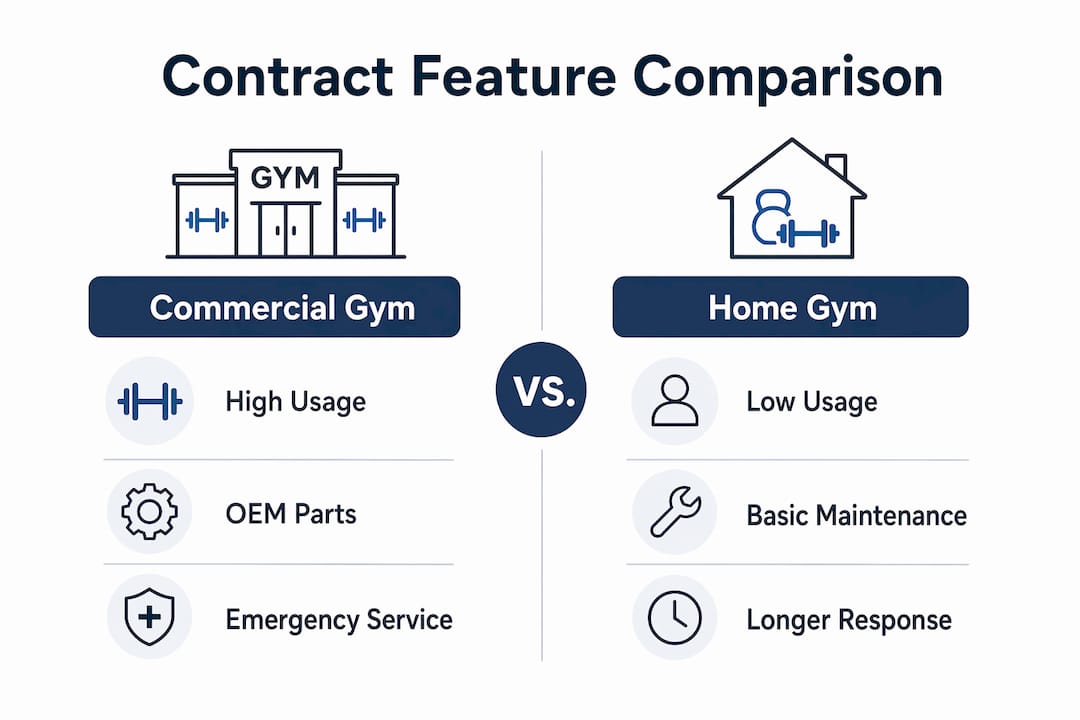
The scope, pricing, and service depth of a multi gym repair service contract shift significantly depending on whether you run a commercial facility or a private home gym with multiple units.
Commercial facilities running 10 to 20 treadmills need contracts that account for daily multi-user traffic, peak-hour wear patterns, and regulatory compliance. Multi-unit contracts for 5 to 20 treadmills scale from roughly $1,100 to $2,200 per year for a 5-unit facility up to $3,800 to $5,400 per year for a 20-unit operation, with emergency priority included. That pricing structure rewards volume, which is the primary financial argument for bundling all your machines under one agreement.

Home gym users managing two to four treadmills have different needs. Usage frequency is lower, emergency response windows are less critical, and the compliance documentation requirements are lighter. Flexible or simplified packages work well here, often covering two annual preventive visits and parts at cost rather than full OEM inclusion.
The cost comparison between preventive and reactive approaches is where the math becomes impossible to ignore. Preventive maintenance runs $400 to $600 per treadmill annually and extends equipment life by 20 to 30%. Reactive repairs cost $600 to $1,000 or more per incident. For a 10-unit commercial gym, that difference compounds fast.
| Facility type | Recommended contract features | Estimated annual cost |
|---|---|---|
| Commercial gym (5 units) | 4 visits/year, OEM parts, 2-4 hr SLA | $1,100 to $2,200 |
| Commercial gym (20 units) | 4 visits/year, OEM parts, priority emergency | $3,800 to $5,400 |
| Home gym (2 to 4 units) | 2 visits/year, parts at cost, flexible scheduling | $300 to $800 |
Beyond cost, bundled contracts simplify vendor management. One provider, one invoice, one point of contact for all machines. That operational simplicity has real value when you are running a facility and cannot afford to coordinate three separate service calls in a single week. Selecting a provider based on local service network strength reduces both downtime and long-term costs more reliably than choosing on price alone.
How to negotiate and implement a service contract
Getting the right contract in place requires more than accepting the first proposal a service company sends. Follow these steps to protect your investment and get real value from your treadmill maintenance agreement.
-
Assess your environment and usage. Count your machines, note their brands and models, and document how many hours per day each unit runs. A Precor 956i in a 24-hour gym needs different coverage than a NordicTrack T 9.5 S used twice a week at home.
-
Request detailed written proposals from at least two providers. Ask each one to specify OEM parts sourcing, technician certification level, and emergency response guarantees. Vague proposals signal vague service.
-
Verify manufacturer authorization. A provider authorized by Life Fitness or Matrix can source genuine parts and maintain warranty validity. An unauthorized technician working on a machine under manufacturer warranty can void that coverage entirely.
-
Read the fine print on SLA penalties. If a provider misses a 4-hour emergency response window, what happens? A contract without penalty clauses is a promise with no teeth.
-
Evaluate the local service network. Facilities without in-house maintenance expertise benefit most from third-party contracts that guarantee faster response and consistent quality. Confirm that your provider has technicians physically located within a reasonable distance of your facility.
-
Set up internal documentation procedures. Assign a staff member to receive and file signed service reports after each visit. Tracking maintenance history protects you during insurance audits and liability claims.
-
Schedule service visits on your calendar before the contract starts. Do not wait for the provider to initiate. Proactive scheduling prevents visits from slipping past their due dates.
Pro Tip: Before finalizing any contract, check whether your treadmill models qualify for the provider’s OEM parts network. Some older Precor or Cybex models have limited parts availability, which can extend repair timelines even under a premium contract.
What pitfalls should you avoid with multi treadmill contracts?
The most expensive mistakes in commercial treadmill service happen before the first technician ever shows up. These are the errors that reduce contract value or create legal exposure.
Choosing labor-only contracts is the most common and costly mistake. Labor-only contracts are false economies because parts are the primary failure point in treadmills, and retail markup on motors, belts, and circuit boards adds up fast. Always confirm parts coverage before signing.
Ignoring climate adjustments creates a false sense of security. A manufacturer’s global service schedule is built for average conditions. If your facility sits in a high-heat, high-humidity region, standard schedules underserve your equipment and accelerate component failure between visits.
Skipping documentation requirements is a legal risk that most facility owners underestimate. Signed service reports per machine are not administrative overhead. They are your defense in a liability claim if a member is injured on a machine with no maintenance record.
Selecting uncertified technicians to save money is a short-term decision with long-term consequences. Unauthorized repairs can void manufacturer warranties on machines that still have coverage, turning a $200 repair into a $2,000 replacement.
Contracts without emergency SLA penalty clauses are not service agreements. They are aspirational documents. If your provider misses a response window with no financial consequence, you have no leverage and no protection.
Emergency call-outs without a contract average $70 to $160 per visit before parts. For a 10-unit facility with even moderate breakdown frequency, that cost quickly exceeds the annual price of a structured contract. The math favors the contract every time.
Understanding why repairs fail quickly is also worth your time before you commit to any provider. A pattern of repeat failures on the same machine often signals that the root cause was never addressed, which is a technician quality problem, not a parts problem.
Key takeaways
A well-structured multi treadmill repair service contract with OEM parts, certified technicians, signed service reports, and a penalty-backed emergency SLA is the most cost-effective way to manage multiple treadmills in any facility.
| Point | Details |
|---|---|
| OEM parts coverage is non-negotiable | Labor-only contracts expose you to retail markup and unpredictable repair costs. |
| Preventive beats reactive on cost | Preventive maintenance saves $200 to $400 per treadmill annually compared to reactive repair. |
| Climate adjustments protect equipment | Standard manufacturer schedules underserve machines in high-heat or high-humidity environments. |
| Documentation reduces legal liability | Signed per-machine service reports are your defense in insurance audits and injury claims. |
| Local network strength drives uptime | A provider with nearby technicians delivers faster response than one with a national call center. |
What I’ve learned from watching gyms get burned by bad contracts
I have seen facility owners in South Texas sign contracts that looked solid on paper and delivered almost nothing in practice. The pattern is consistent: the contract covers labor, the technician shows up quarterly, and the moment a motor burns out or a belt shreds, the owner gets an invoice for parts that costs more than three months of contract fees.
The facilities that manage this well share one habit. They treat the service contract as a legal document, not a maintenance calendar. They read every clause about parts sourcing, they confirm technician certification before the first visit, and they build maintenance schedule tracking into their operations from day one. That documentation habit pays off the first time an insurance adjuster asks for service records.
My honest recommendation for any facility running five or more treadmills: do not evaluate contracts on annual price alone. Evaluate them on what happens when something goes wrong at 6 a.m. on a Monday. Does your contract guarantee a technician on-site within four hours? Does it cover the replacement motor, or just the labor to install it? Those two questions separate real coverage from a piece of paper.
For home gym users managing multiple units, the calculus is simpler but the principle is the same. A contract that includes two annual visits and parts at cost will always outperform calling a random technician when something breaks. Knowing your treadmill’s repair condition before you sign also helps you avoid paying for coverage on a machine that is already past its useful life.
— Steve
Get covered with Texastreadmillrepair’s multi-unit service plans

Texastreadmillrepair serves fitness facilities and home gym owners across South Texas with certified treadmill repair services built for multi-unit operations. Every contract includes certified technicians, OEM parts, and same-week scheduling so your machines stay running without surprise fees. The flat-rate pricing model means you know exactly what coverage costs before any technician arrives. Whether you manage a commercial gym fleet or a private multi-treadmill setup, Texastreadmillrepair builds plans around your usage, your environment, and your budget. Contact Texastreadmillrepair today for a free consultation and a written quote on a service plan that actually protects your equipment.
FAQ
What is a multi treadmill repair service contract?
A multi treadmill repair service contract is an agreement covering preventive maintenance, emergency repairs, OEM parts, and certified technician visits for multiple treadmill units under one plan. It replaces unpredictable one-off repair costs with a fixed, structured maintenance program.
How much does a multi-unit treadmill service contract cost?
Annual costs range from $1,100 to $2,200 for a 5-unit facility and $3,800 to $5,400 for a 20-unit operation, with emergency priority included. Home gym plans covering two to four units typically run $300 to $800 per year depending on parts coverage.
Are OEM parts required in a treadmill maintenance agreement?
OEM parts coverage is strongly recommended because parts are the primary failure point in treadmills and labor-only contracts expose you to retail markup on every component replacement. Parts-included contracts deliver predictable budgeting and preserve manufacturer warranty validity.
How often should treadmills be serviced under a commercial contract?
Commercial treadmills require at least four preventive maintenance visits per year, with service intervals adjusted for local climate and usage intensity. High-heat or high-humidity environments like South Texas may require more frequent visits than standard manufacturer schedules recommend.
What happens if a service provider misses an emergency response window?
Contracts with written SLA penalty clauses require the provider to compensate you financially if they miss the agreed response time, typically two to four hours for commercial facilities. Without penalty clauses, a missed response window carries no consequence for the provider and no protection for you.