What Is Treadmill Refurbishment: a Buyer’s Guide
Treadmill refurbishment gets thrown around constantly in fitness equipment listings, but few buyers actually know what it means. It is not a cleaning, not a tune-up, and not a vague promise that the machine “works great.” Understanding what is treadmill refurbishment before you buy or schedule service is the difference between a smart investment and an expensive mistake. This guide breaks down exactly what the process involves, how it compares to your other options, what it should cost, and how to tell the good from the bad.
Table of Contents
- Key takeaways
- What treadmill refurbishment actually involves
- Refurbished vs. remanufactured vs. used treadmills
- Benefits and drawbacks of treadmill refurbishment
- How to evaluate refurbishment quality and vet dealers
- Maintenance tips after refurbishment
- My honest take on the refurbishment market
- Keep your treadmill running with Texastreadmillrepair
- FAQ
Key takeaways
| Point | Details |
|---|---|
| Refurbishment is a full restoration | It includes teardown, parts replacement, and testing — not just cleaning or a quick tune-up. |
| “Certified refurbished” can be misleading | Most certifications are dealer-issued, not manufacturer-backed, so you need to verify the process yourself. |
| Cost savings are real but variable | Refurbished commercial treadmills typically sell for 40 to 60 percent of original retail price. |
| Longevity depends on maintenance | A well-refurbished treadmill can last 7 to 10 years at home with consistent upkeep. |
| Dealer vetting is non-negotiable | Ask for documentation, photos of the process, and warranty terms before you commit to any purchase. |
What treadmill refurbishment actually involves
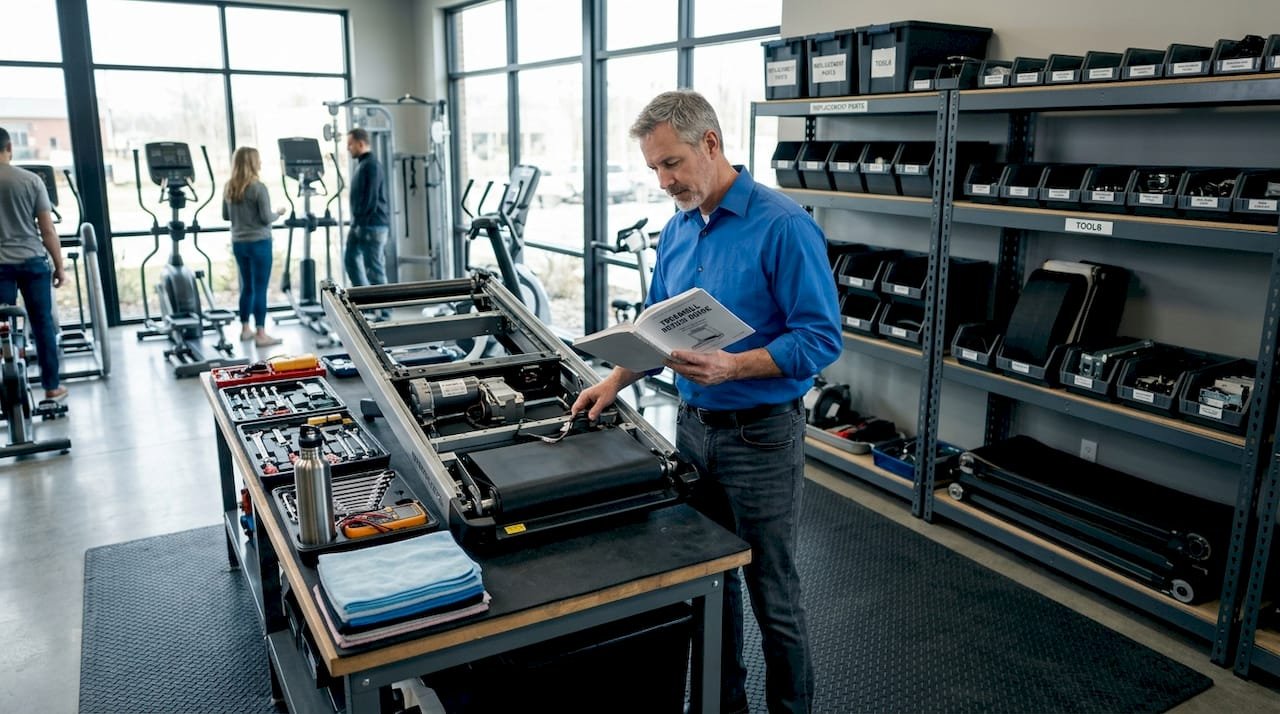
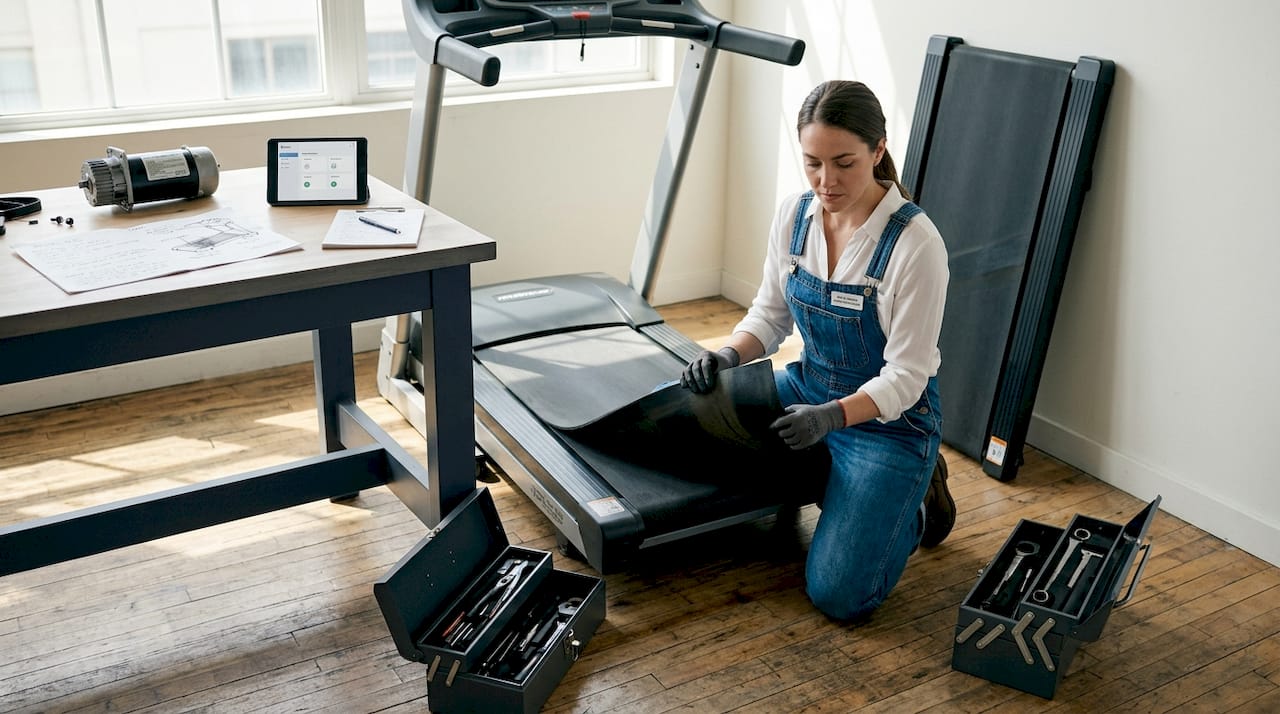
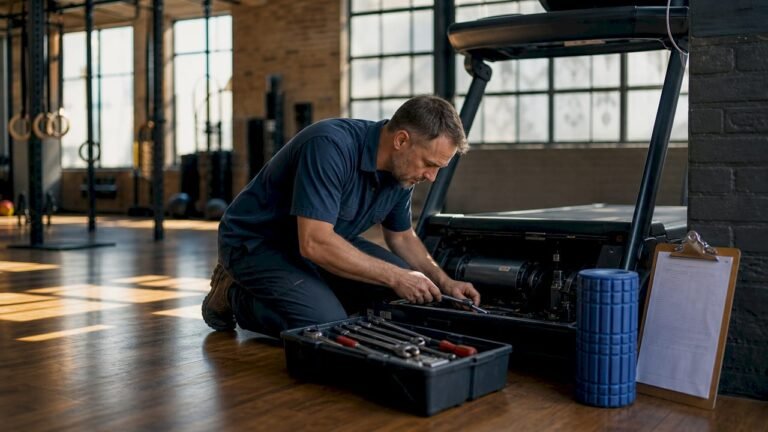
Treadmill refurbishment is a structured mechanical and cosmetic restoration process designed to return a used machine to near-new working condition. It is not a surface-level fix. The full refurbishment process involves disassembly, inspection of every major component, systematic parts replacement, reassembly, calibration, and stress testing before the machine is considered ready.
Here is what a genuine refurbishment looks like from start to finish:
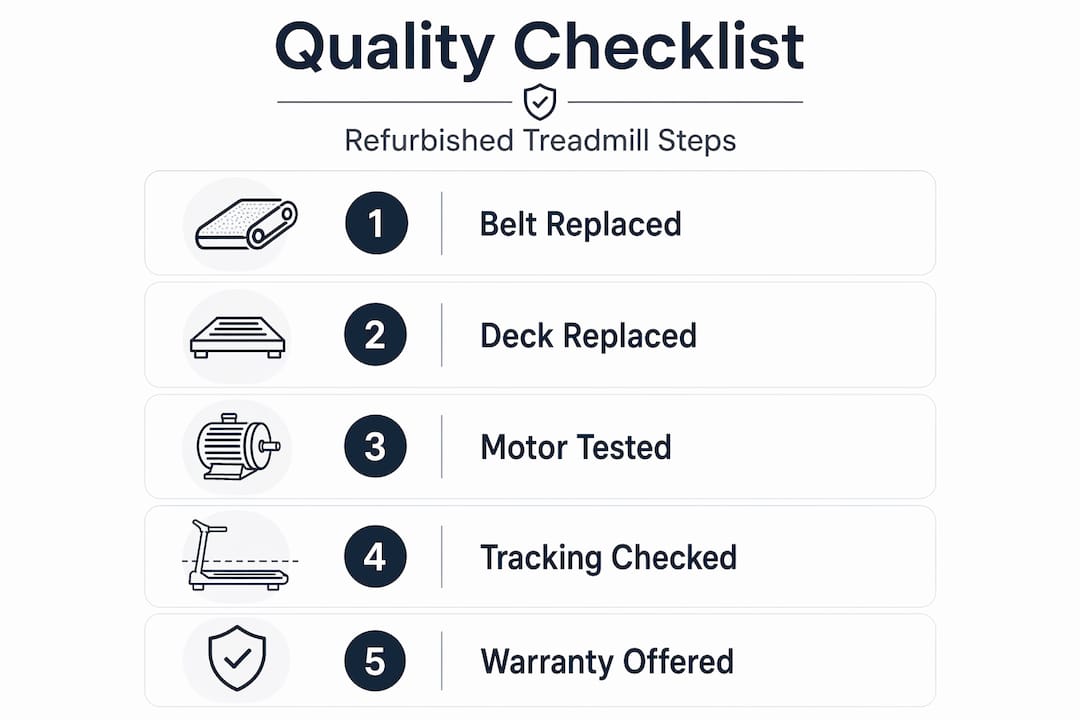
- Full disassembly. The treadmill is broken down to its frame. Motor covers come off, the console is disconnected, and the running deck is exposed for direct inspection.
- Component inspection. Technicians evaluate the motor, controller board, rollers, belt, deck surface, bearings, and frame for wear, damage, or failure. Nothing is assumed to be fine.
- Parts replacement. The running belt, deck, and bearings are replaced as a standard step, not an optional add-on. A 42-point inspection process guides what else needs to go.
- Frame cosmetics. The frame is typically repainted or powder-coated. Console surfaces are cleaned, repaired, or replaced as needed.
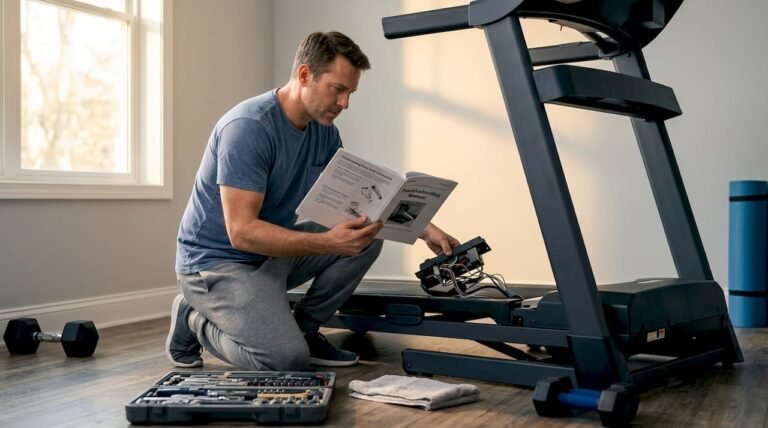
- Reassembly and calibration. The machine is reassembled and calibrated to manufacturer specifications for speed accuracy and incline response.
- Stress testing. The treadmill runs through a full test cycle before it ships or gets delivered. This is how quality gets confirmed, not assumed.
The distinction between cosmetic and mechanical refurbishment matters a lot. Cosmetic work is straightforward: new paint, cleaned panels, replaced display covers. Mechanical refurbishment is where the real value is. Consistent belt and deck replacement is what separates a genuine refurbishment from a machine that was wiped down and relisted. Skipping those wear items is the most common shortcut bad refurbishers take, and it leads to the same problems returning within months.
Pro Tip: Ask any seller to confirm in writing that both the belt and deck were replaced as part of the refurbishment. If they hesitate or cannot provide documentation, treat that as a red flag.
Refurbished vs. remanufactured vs. used treadmills
These three terms get used interchangeably online. They should not be. Each represents a meaningfully different level of work, risk, and warranty coverage.
| Category | Rebuild depth | Typical warranty | Best for |
|---|---|---|---|
| Used | None | None | Budget buyers, short-term use |
| Refurbished | Partial to full, varies by dealer | 30 to 90 days typical | Home use with moderate budget |
| Remanufactured | Full rebuild to factory spec | 6 months to 1 year or more | Heavy users, shared-use gyms |
A remanufactured treadmill goes further than a refurbished one. Every subsystem is rebuilt to factory-equivalent standards. The motor is not just tested, it is rebuilt or replaced. The controller board is not just wiped down, it is evaluated against OEM specs and swapped out if it falls short. Remanufactured machines carry stronger warranties and are better suited to commercial or heavy-use environments.
A used treadmill is simply a used treadmill. No restoration work was done. The price reflects that, but so does the risk.
Here is when each option makes the most sense:
- Used: You need something short-term, you have a tight budget, and you are comfortable doing your own inspection before buying.
- Refurbished: You want significant cost savings on a machine that has been evaluated and restored, and you are buying for personal home use with light to moderate traffic.
- Remanufactured: You run a small gym, share a treadmill with multiple household members, or you want the closest thing to new without paying new prices.
One important note: remanufactured machines are clearly the better fit for serious users and shared environments. If you are the only person using the machine for 30 minutes a day, a properly refurbished unit is likely all you need.
Benefits and drawbacks of treadmill refurbishment
The case for refurbishment is strong, but it is not unconditional. Understanding both sides helps you make the call that fits your situation.
The financial argument is the most obvious starting point. Refurbished commercial treadmills typically sell for 40 to 60 percent of their original retail price. A Life Fitness or Precor model that retailed for $5,000 new might sell for $2,000 to $3,000 refurbished. That is real money, and on quality commercial-grade machines, it buys you significantly better hardware than a brand-new budget treadmill at the same price.
Lifespan is the other major win. Refurbished treadmills can last 7 to 10 years in a home setting when the refurbishment was done correctly and the owner follows a basic maintenance schedule. That is a strong return on a machine that costs far less than new.
Benefits at a glance:
- Access to commercial-grade machines at a fraction of new prices
- Major wear parts are already replaced, so you are not inheriting problems
- Environmental benefit of keeping functional machines out of landfills
- Potential for a warranty, which a used purchase almost never includes
Drawbacks to weigh honestly:
- Quality varies enormously between refurbishers with no industry standard enforced
- Warranty coverage is often shorter and narrower than new equipment warranties
- Older machines may have discontinued parts, complicating future repairs
- You are unlikely to get manufacturer support if something goes wrong
Pro Tip: If you are choosing between refurbishing your current treadmill and buying a refurbished replacement, factor in the age of your machine. A well-built commercial unit that is 8 years old is often a better candidate for refurbishment than a cheap residential model of the same age.
How to evaluate refurbishment quality and vet dealers
The phrase “certified refurbished” sounds reassuring. It often is not. Most dealer certifications are self-issued. The dealer decides what their own standard is, certifies their own work, and calls it done. Manufacturer-backed certifications in the treadmill market are rare. That means the burden of verification falls on you as the buyer.
Here is how to vet a dealer before you spend a dollar:
- Ask for a process walkthrough. Any reputable refurbisher should be able to describe, in specific detail, exactly what was done to the machine you are considering buying. Vague answers like “we fully inspected everything” are not enough.
- Request documentation and photos. Documented refurbishment with photos of the disassembly and replaced parts is a strong signal of a dealer who takes quality seriously. If they cannot show you, they probably did not do it.
- Clarify the warranty terms in writing. What does the warranty cover? How long does it last? Is labor included? A dealer who gets evasive about warranty specifics is telling you something important.
- Distinguish dealer certification from manufacturer certification. Ask directly: “Is this certification from you or from the manufacturer?” Knowing the answer changes how much weight you give it.
- Check responsiveness. How quickly does the dealer respond to your questions? Dealer responsiveness before the sale is the most reliable predictor of support after it.
Signs of a poorly refurbished machine include uneven belt tracking right out of the box, a motor that runs loud or surges under load, a console that flickers, and wear marks on the deck surface that were clearly not addressed. These are not minor issues. They indicate the treadmill repair process was either rushed or skipped in key areas.
Maintenance tips after refurbishment
Getting a well-refurbished treadmill is step one. Keeping it in good shape is what actually determines whether you get 3 years or 10 years out of it.
Routine maintenance tasks that extend the life of any refurbished treadmill include:
- Lubricating the deck every 3 months or every 40 hours of use, whichever comes first. Most treadmills use 100 percent silicone lubricant applied under the belt at the center of the deck.
- Checking belt tension and tracking monthly. A belt that slips or drifts to one side puts extra stress on the motor and rollers.
- Inspecting the motor area for dust buildup every 6 months. Overheating motors are one of the most common causes of treadmill failure in South Texas homes where heat and humidity accelerate wear.
- Testing the console and safety key before every session. Electronics are often the first thing to show signs of age on a refurbished machine.
- Listening for new sounds. Grinding, clicking, or squeaking that develops gradually is almost always a wear signal, not a random noise.
The practical decision rule for repairs is simple: if repair costs exceed 50 percent of what a comparable new treadmill costs, replacement becomes the more financially sound choice. Below that threshold, repairing and maintaining your current machine usually wins. For South Texas residents dealing with local treadmill issues, getting a certified technician out for a diagnostic before assuming the worst can save you from a premature replacement decision.
My honest take on the refurbishment market
I have spent years working around treadmill equipment, and the thing I see most often is buyers who got burned by marketing language they trusted without verifying. “Fully refurbished” and “certified” are phrases that cost nothing to print on a listing. What they mean in practice varies wildly.
The dealers I respect are the ones who respond to detailed questions without getting defensive. They send photos unprompted. They explain what they replaced and why. They tell you what they found and what they left alone, and they give you a clear warranty that does not require a law degree to understand.
What I have learned is that the process audit is everything. A quality treadmill refurbishment is not about a shiny coat of paint. It is about whether the belt and deck were replaced consistently, whether the motor was genuinely tested under load, and whether somebody ran the machine long enough to catch problems before it left the shop.
My advice: be patient. A good refurbished treadmill at a fair price from a reputable dealer is worth waiting for. A mediocre one bought in a hurry because the price looked right will cost you more in repairs and frustration than you saved.
— Myles
Keep your treadmill running with Texastreadmillrepair

If you are weighing your options after researching treadmill refurbishment, Texastreadmillrepair is built for exactly this moment. They serve South Texas homeowners and gym owners who need straight answers and reliable service, not guesswork. Their certified technicians come directly to your location with same-week availability, flat-rate pricing, and a 90-day warranty on all parts and labor. Whether you need a full assessment of a recently purchased refurbished unit, ongoing maintenance to protect your investment, or repairs on a machine that is showing signs of wear, you can explore all available treadmill repair services and book directly on their site.
FAQ
What does treadmill refurbishment include?
Treadmill refurbishment includes full disassembly, inspection, replacement of worn parts like the belt, deck, and bearings, cosmetic restoration, reassembly, calibration, and stress testing before the machine is considered ready for use.
How much does treadmill refurbishment cost?
Refurbished commercial treadmills typically sell for 40 to 60 percent of their original retail price, though the exact cost depends on the model, the refurbisher, and the scope of work completed.
Is a refurbished treadmill worth buying?
Yes, if the refurbishment was done properly. A well-refurbished treadmill can last 7 to 10 years in a home setting, making it a strong value compared to buying new at full price.
What is the difference between refurbished and remanufactured?
Refurbished means the machine was inspected and restored to working condition with key wear parts replaced. Remanufactured means a complete rebuild to factory-equivalent standards, which typically includes a stronger warranty and is better suited for heavy or shared use.
How do I know if a refurbished treadmill is good quality?
Ask the dealer for documentation of the work completed, photos of disassembly and replaced parts, and clear written warranty terms. Reputable dealers will provide all three without hesitation.

One Comment